


Disruption doesn’t create chaos.
Often, we frame disruption as the moment operations begin to break down. Disaster strikes. Airspace restrictions change. Supply chains stall. Systems go offline.
But disruption rarely creates chaos from nothing. More often, it exposes the limits of how well an operation was really aligned in the first place.
In stable conditions, most organisations are able to absorb a surprising amount of inconsistency. Teams fill gaps with experience, communication bridges what systems don’t capture, and workarounds quietly keep things moving. The operation appears controlled, even if that control is partly informal.
When conditions change, that buffer disappears. Decisions need to be made faster, information moves more quickly, and cross-functional teams must work together in real-time. What was previously manageable becomes visible.
Differences in understanding between teams.
Updates that don’t reach everyone at the same time.
Actions that are discussed but not clearly owned.
Decisions that are made but not consistently captured. Nor their reasoning.
None of these issues are new. They were always present, just not under enough pressure to matter. So, it’s worth repeating; disruption doesn’t create chaos. It reveals whether the system behind the operation was ever keeping pace with reality.

The cost of fragmentation
If disruption reveals the cracks, the next question is what do those cracks actually cost?
At first, it doesn’t look like failure. In fact, from the outside, it can look like a strong response. Teams move quickly, decisions are made, and actions are taken. The operation keeps moving. But underneath that momentum, something more subtle begins to happen.
Information starts to fragment.
Updates are shared across multiple channels, often at different times, to different groups. Teams begin to act on slightly different versions of the same situation. Decisions are made in parallel, without always being visible to everyone they affect. Actions are discussed but not always tracked through to completion.
Individually, none of this feels unusual. It’s how many operations function day to day. But under pressure, the gaps between those fragments start to widen.
A team reacts to an update that another team hasn’t seen yet.
A decision is made based on information that has already changed.
An action is assumed to be in progress but isn’t owned by anyone.
And gradually, the operation becomes harder to read, even for the people inside it.
This is where the real cost begins to emerge.
Not just in delays or disruption, but in the loss of a clear, shared understanding of what is actually happening. What decisions have been made. What actions are underway. What has changed, and why.
Because when that clarity is missing, everything else becomes harder. Coordination slows. Confidence drops. And once the moment has passed, the operation has to be reconstructed rather than simply understood.
The disruption may only last minutes. The effort to explain it can take hours.
Why more communication doesn’t solve it
When fragmentation appears under pressure, the instinctive response is almost always the same: communicate more. More updates. More check-ins. More channels. More visibility efforts. The assumption is simple: if things are unclear, the answer must be to share more information. But in practice, disruption rarely creates a lack of communication. It creates an excess of it.
Information starts moving faster, not slower. Updates are repeated, forwarded, reworded, and redistributed across different tools and teams. Conversations multiply. Notifications increase. Visibility efforts intensify.
Yet clarity does not improve in proportion to the volume.
The reason is not effort. Teams are communicating constantly. The issue is structure.
Information is being shared but not consistently aligned. Updates are visible in one place, referenced in another, and acted on somewhere else entirely. The same event can exist in multiple versions across the organisation, depending on when and where it was seen.

Teams can spend more time reconciling updates than acting on them. Conversations become reactive rather than coordinated. And instead of creating alignment, communication begins to generate additional interpretation work.
What is missing is not information. It is a shared operational context that stays relevant as conditions change. Without that, every new update requires interpretation. Every action requires confirmation. Every decision carries the risk of being based on something already out of date.
And so, the system becomes louder, but not clearer.
The importance of operational clarity
So, what’s missing?
It is not more data. Most operational environments already produce an overwhelming amount of information in real time. Updates, alerts, messages, and status changes are constant. The challenge is not access to information. It is the absence of structure around it.
What operations actually require under pressure is a way to keep information connected as it moves – so that events, decisions, and actions are not just visible in isolation, but understood in context.
Because in fast-moving environments, nothing exists on its own. A single change can trigger a chain of operational responses across multiple teams. Without a structured way of capturing that chain, the operation becomes fragmented almost immediately.
This is where clarity is either preserved or lost. How information is recorded, connected, and carried forward as the situation evolves.
When decisions are separated from their rationale, when actions are separated from ownership, and when updates are separated from their operational context, teams are left to reconstruct meaning as they go. That reconstruction is where friction enters the system.
What emerges from this is a subtle but important distinction.
Visibility tells you something has changed.
Clarity tells you what it means, what was done about it, and what happens next.
And in operational environments where conditions can shift rapidly, that distinction becomes critical. Because the difference between responding to information and operating from a shared understanding is where control is either maintained or gradually lost.
What a system built for clarity looks like
Most operational environments still treat information as something that is shared after the fact, through updates, summaries, or reports. In fast-moving situations, that is too slow and too fragmented. Clarity depends on something more fundamental: structure at the point of capture. A system built for this works differently.
Information is recorded once, as it happens, and immediately becomes available to everyone who needs it. It is not repeated across channels or reshaped through separate conversations. It exists in a single, shared operational context.
More importantly, it is not just a record of events. Each update is connected to the decisions it leads to, the actions that follow, and the people responsible for delivering them. That connection is what prevents fragmentation under pressure. In this model, alignment does not rely on constant communication. It is maintained by design. Everyone is working from the same live picture of the operation, not their own interpretation of it.
And because the context is preserved as the operation evolves, there is no need to reconstruct what happened afterwards. Decisions, actions, and rationale already exist as part of the same continuous record.
Digital shift logs
This is the gap most operational environments are now trying to close. The absence of a structured, real-time record of what is happening as it happens. Something solved by implementing a digital shift log.
Instead of updates being scattered across channels or reconstructed after the fact, operational information is captured once and shared instantly in a single, continuous flow. Events, decisions, and actions sit in the same place, in the same context, as the operation evolves.
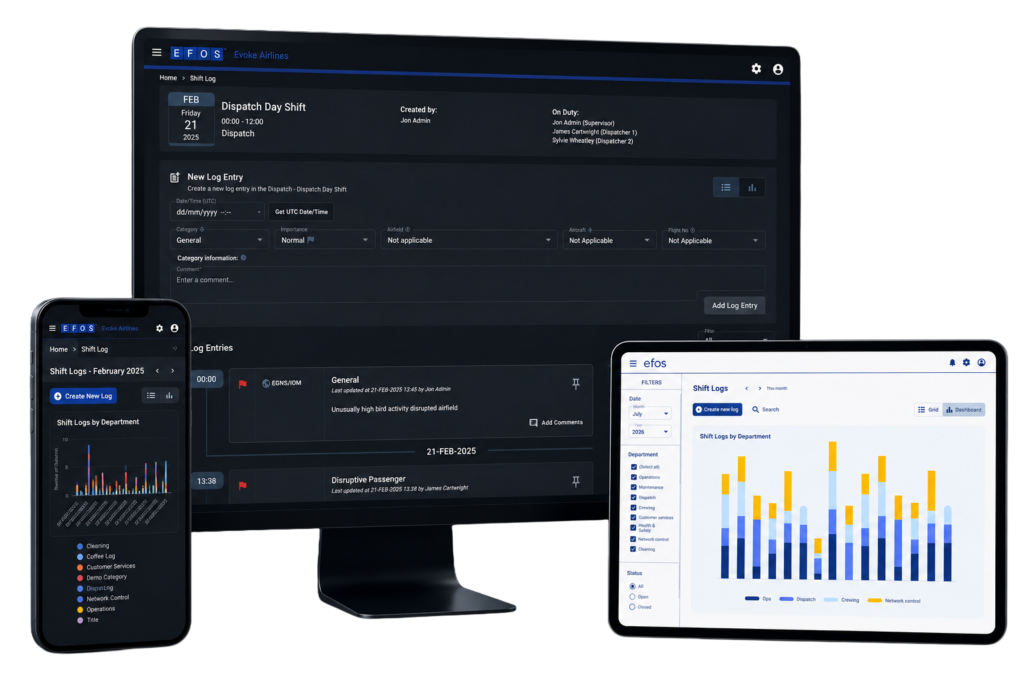
And when disruption does occur, the difference is immediate. Teams are not trying to piece together what happened. They are working from the same live operational record that already contains it.
That is what closes the gap between visibility and clarity.
Not more communication. Not more tools.
A single, structured shift log that reflects the operation as it unfolds.


